he
following is a summary of the development of the BetaSpace
project. he
following is a summary of the development of the BetaSpace
project.
Spring/Summer
2002
- Learn more about the project conception and development of BetaSpace in the
initial stages of the project.
Fall Quarter
2002
- The project officially kicks off in this exploratory and introductory quarter.
Winter Quarter
2003
- Massive site building and development takes place in this most productive quarter.
Spring
Quarter 2003 -
BetaSpace undergoes an overhaul of all it's dynamic
elements, marketing and promotion moves to the
front burner, individual projects are finished
and all the pieces start to fall into place...
::::::::::::::::::::::::::::::::::::::::::::::::::::
Spring/Summer 2002:
::::::::::::::::::::::::::::::::::::::::::::::::::::
The beginnings of the BetaSpace concept
date back to the 'Intro. to Project Development' class
of CSUH during the Spring 2002 quarter, where individual
multimedia graduate students presented their ideas for
possible thesis topics. The four future members
of BetaSpace separately presented their own proposals
[Jay
- 'The MI Discovery Project', Liam
- 'Intersecting Introspections', Eric
- 'Databases', & Ethan - 'Storytelling'], but all ideas
shared a common
ground
-- using the Internet
as a
means
to reach
people, not just on a superficial level but at a level
that has been vastly underutilized thus far.
Towards the end of the Spring 2002 quarter,
Jay, Ethan and Liam decided to form a group around the
concept of multiple intelligences, in hopes of giving
people an online venue for people to explore their various
talents and 'intelligences' (visual-spatial, musical,
kinesthetic, etc). The group created a presentation for
the graduate thesis committee and began to research the
project further in June. However, following a near group
meltdown concerning overall interest in pursuit of the
'multiple intelligences' project idea, the team members
decided to scrap the MI
concept and went back to
the drawing board and did some brainstorming and soul-searching
about what they were
truly
interested
in researching
and developing over the course of the next year.
The idea that eventually came out of the
breakdown, soon to be called 'BetaSpace', encompassed
the group's desire to create an open, online venue for
personal artistic expression. Frustrated by the recent
denouncement of the promise of the Web because of commercial
failures, the group aimed at returning the Web to the
promise it once seemed to hold as the greatest conduit
of personal expression in history. The
following quote from our project
proposal explains this conceptual justification further:
Nearly 10 years after its inception, the
World Wide Web stands at a pivotal crossroads in terms
of its future as potentially the greatest communications
medium to date. With memories still fresh in our minds
of the ephemeral rise and fall of the dot-com era, our
society has become more restrained and skeptical than
ever concerning the hopes, promises, and future of the
Web. What once was hoped for as the ultimate equalizer
in communications accessibility and empowerment, the
medium has now been diminished by conservative calls
for stricter guidelines on usability, profit-making potential,
and fundamental shifts in how to conduct business in
the online world. Lost in this economic reshuffling seems
to be the empowering artistic and humanistic promise
that the Web once seemed to hold, and the vast avenues
for creative expression that are already widespread in
all other formats of media in our society.
The BetaSpace group believes the Internet is not just
a set of technologies, connecting machines and people
across vast distances. We view these enabling technologies
more as a channel to transmit our own voices, stories,
and experiences in a highly influential, unrestricted
way to those who care enough to listen, and to those
who would like to contribute to that artistic sentiment
as well.
Therefore, the group began developing
the concept on an online art gallery, utilizing the
empowering self-publishing nature of the Internet,
as well as promoting
the status of new media art as a "legitimate" art
form, which up to this point has been vastly neglected
in "traditional"
art museums. Later on, an online community component
was added to the BetaSpace concept, in hopes of connecting
artists across distances, to share and nurture ideas,
as well as to promote the untapped potential of collaborative
art making, which is well suited to an open source,
remotely accessible venue like the Internet.
Over
the course of the summer 2002 months, the group
brainstormed personal art project
ideas, researched several existing
'online museum' Web sites, researched experimental
new media art sites, and researched sites
with experimental navigation. We also discussed
different options for the database-driven components
of the site. In
August, some group members went to
a Cold Fusion MX seminar to research the potential
of the product, and also came across our fourth team
member, Eric, who decided to join the team in August.
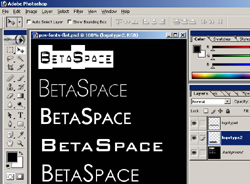
Some additional tasks for the summer included brainstorming
potential names, typefaces, and logos for the project,
looking at potential
Web
hosting
options,
and producing our thesis project proposal,
which we turned in at the beginning of the Fall 2002
quarter.
Meeting notes and important correspondence from Spring/Summer
2002
Return to top
::::::::::::::::::::::::::::::::::::::::::::::::::::
Fall 2002:
::::::::::::::::::::::::::::::::::::::::::::::::::::
For the Fall quarter of 2002, several milestones were completed,
including the finalization of the project’s logo, main site conceptualization,
documentation site
launch,
ftp server setup, and site hosting (on our own server).
On the technical end, the server was set up for FTP, and hosting
our site online. FTP was originally planned for allowing people to submit
their
work to us via our server. People would be able to upload their work for us to
evaluate, and then we would decide if we were going to post their artwork
on our site. In addition, our plan was to host our site
on the school server and install ColdFusion MX.
Additionally, we were in the planning stages of designing the
back-end components of “Free
for All” (later called “Community Access”) and “Collaborative
Studio.” ColdFusion was one of the first options for the scripting language
for our site’s Web development because of its association with Dreamweaver
MX, which was our main editor tool for the site. MySQL was the chosen as the
database
software. Login pages were developed using ColdFusion in the beginning, but,
as our project went further into the development cycles, we decided to explore
other
languages available, and their capabilities. ASP.NET and PHP were among the few.
PHP was finally picked as the language because it was free and had a supportive
community for resources of information on building tools driven by PHP.
Once PHP was chosen, we started to look into existing community
software to build upon.
Programs such as Easy Forum and PHPbb2
were
some
of the considerations. Easy Forum was appropriate for the “Free for All”
section, which mainly served as a dynamic information exchange venue.
However, “Collaborative
Studio” required more robust components, such as group permissions and
upload/download functionality. PHPbb2 provided a very structured user interface
for
forums and group permissions administration, and we were working on implementing
the
upload/download
components to PHPbb2 during the quarter.
During the conceptualization of the main site, we continued to
conduct research on how to display artwork and how to create an interesting
navigational
system for people. Our intention was to display artwork in a un/defined space
that would suit well with our site’s name “Betaspace.” We looked
at sites that had a very physical definition of space. Themes such as 'artists’
party', 'lounge', and 'sidewalks' were considered as contained spaces to host
artwork. The idea of people roaming around and across space while looking at
artwork
on
the side was developed. We also explored using a slider function to simulate
traveling. When a user moved his cursor from left to right or vice versa on the
Flash movie,
the
panel inside the movie where the cursor lied would also move in the same direction
as the cursor and would display artworks. We chose this as our final navigational
strategy for the galleries.
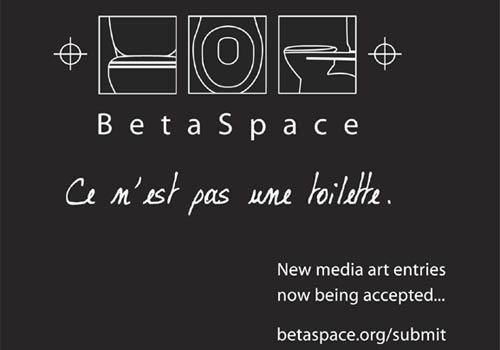
Our logo was also finalized in this stage. We designed several
prototypes
ranging from a 3 dimensional cube to a toilet. We chose to include a toilet in
our logo, based upon an updated version of Marcel Duchamp's Fountain (the
infamous 1917 urinal), but
keeping his same intent that 'art is what the artist says it is' (in our case,
defining new media art as a legitimate 'art' form).
Information architecture for the main site was also completed.
We came
up with six sections including “Collaborative Studio,” “Free
for All,” "Creators Exhibit" (later to be renamed Beta Genome), "Rotating
Exhibit"
(Progressions), "Themed Gallery" (Functions), and "Featured Artist"
(Underscored).
A template design for the documentation site was also completed.
The site
would host our project description, proposal, development, and biographies of
members.
Meeting notes and important correspondence
from Fall 2002
Return to top
::::::::::::::::::::::::::::::::::::::::::::::::::::
Winter 2003:
::::::::::::::::::::::::::::::::::::::::::::::::::::
During the academic recess between Fall
2002 and Winter 2003 quarters the members of BetaSpace
were gearing up for the site build to take place. Technology
decisions had been finalized, software (we thought)
was chosen, and we were ready to go. Although the site
took much longer than anticipated to plan out, everyone
in the group felt we had a solid idea of what the experience
would be.
The group started from multiple points
on getting the site built: hacking community ware,
doing
production art for our galleries, and trying to glue
all the technology together while parts were still
being
built.
One of the major characteristics of the
winter quarter was the need to adapt plans, almost daily,
to suit the limitations or enhanced capabilities of
our chosen technologies. As more technology got thrown
into the mix of BetaSpace, the team realized that some
design decisions would need to be scrapped, while some
aspects we were able to enhance.
Of course there was the coding, and more
coding, and even more coding....
Another important factor of the development
over the winter quarter was the need to communicate
technical details effectively to one another as we were
all developing the site from different directions. While
some were doing art and UI work, others were coding
the guts and functionality of the site. It was essential
that we communicated well not only so that all our parts
fit together, but also when we handed something off
to another group member they knew where to pick up.
As a result the information architecture was undergoing
constant revisions as the group built the project.

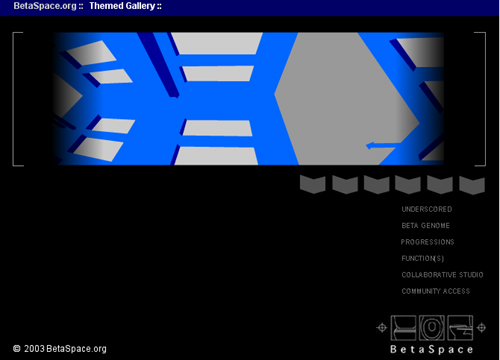
Although the majority of the gallery spaces
were planned for design in Flash MX, the group quickly
realized that since we were also relying heavily upon
the PHP MySQL duo, the use of Flash was ultimately limiting
us in some respects and even causing some problems.
Ultimately the use of Flash MX had to be scaled back
in order to keep all the technology cohesive.
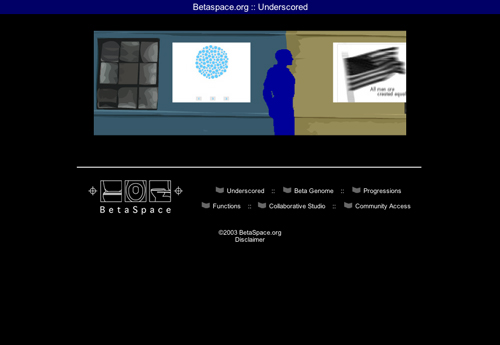
In addition, the creative vision of BetaSpace
also needed some improvement. This came in the form
of small but important details from an experience standpoint.
Our galleries still had the placeholder names assigned
to them during the original project conception from
the summer - the group needed to change these in order
to make the BetaSpace experience one that felt a bit
more creatively driven.
The BetaSpace project also relied on others
participating, and the need to get artwork submissions
for the galleries was becoming intense. The team decided
to solve this by providing an FTP account on our file
server for submission. We realized that abuse of this
policy was probably inevitable, but thought it provided
an easy facilitation for the first round of submissions
while the site was still being built.
Additionally, the group started shifting
a large bit of focus to the marketing and recruiting
of artists
and community participants towards the end of the quarter.
This came at first in the form of an HTML recruitment
email, to be sent not only to our contacts, but also
to be posted on other active communities online. The
rather laborious process of getting the content of
this email took several revisions and a lot of care
was taken
to make sure the HTML was uniform across all platforms.
File uploading was becoming a big concern
also around the time of our switch at the end of the
quarter. People were beginning to abuse the FTP account
for our submissions and the file server was getting
a lot of executable files, viruses, and mp3's uploaded.
It was decided we should facilitate a shut down of
this
process
as soon as we could.
Towards the end of the Winter quarter
the group was finishing up the beta version of BetaSpace,
and some serious decisions had to be made. The FlashForward
conference (where we would be heavily marketing) was
approaching over the Spring break session, and a
lot of debate started to surface over whether the BetaSpace
experience was where we wanted it to be.
Meeting notes and important correspondence
from Winter 2003
Return to top ::::::::::::::::::::::::::::::::::::::::::::::::::::
Spring 2003:
::::::::::::::::::::::::::::::::::::::::::::::::::::
The final quarter of our thesis proved
to be the most productive, challenging and innovative
learning experience thus far.
As was suggested by our advisor, Phil
Hofstetter,
a new timeline was created and revised, especially for
incorporating
all the new changes we were planning for our project.
From our meeting with the committee at the end of the
Winter quarter, we became more dedicated to focusing
our
efforts on building a community, starting with a variety
of ways.
Overhaul of Dynamic Elements
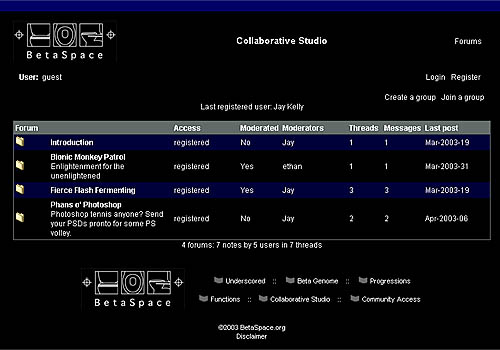
Near the start of the quarter, a lengthy
and somewhat tumultuous debate ensued
on Instant Messenger over
whether the current functionality of our community building
components were adequate for the objectives we had set.
Knowing that we had precious little time
left, the debate over the risks versus the rewards of
changing and expanding the dynamic elements
of the site were examined. What became clear
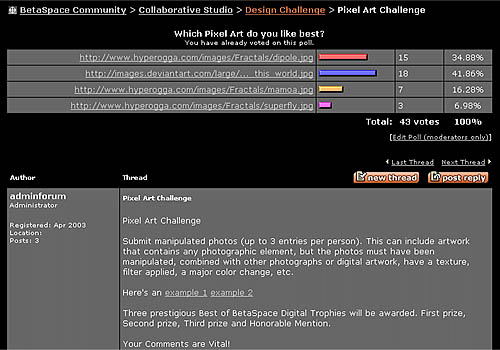
to us, was that without the 'ease of usability' and elements
such as polling, customized moderator
permissions and greater administration controls (just to name a few), our
concept of community building might
not live up to the quality of user
experience we had originally envisioned.
So knowing that we had the old system in place (that we knew worked and could
fall back on if necessary), we decided to go ahead
with the overhaul and implement a new system of
dynamic functionality throughout the project.
This turned out to be a pivotal point in
the scope of the entire project, and none of us have
regretted the added time and energy put into overhauling
the dynamic section. We did however, encounter some initial problems connecting
vBulletin with our host's database, but overall the transition
was fairly smooth,
and we have yet to explore the full complement of functionality
that has been made available to us. As an added bonus,
the transition augmented our learning curve in the arena
of dynamic content development and community building.
User Submissions: A Problem Solved
One
problem we initially had with our submission upload via
FTP, was the use of our server for illegitimate
purposes. In the last quarter
we decide to revise our method of submissions by
having people submit their URL's pointing to work on
THEIR server. This solution proved to serve two purposes/problems that
needed to be solved. We kept a close watch on some of the user
feedback we received,
and adjusted our system to suit people's needs and comments.
At first, we planned on designating a small
group of jurors to curate what would be exhibited in
the various galleries. However, with the new functionality
of dynamic
elements we had acquired, we re-thought the process. In the interest
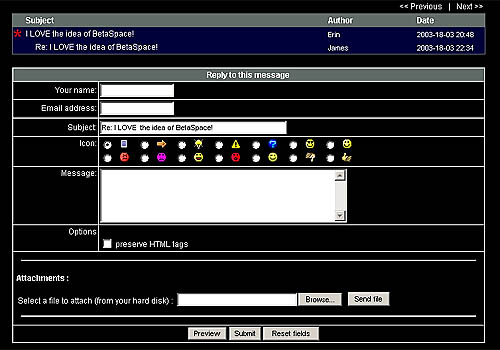
of encouraging greater user participation, we decided
to "let the masses vote", with the restriction that
the 'masses' were registered users. With only registered users permitted
to vote, we are also capable of automatically restricting
people from voting more than once. A preliminary outline
for the Jury Process was proposed.
We finally completely abandoned all physical
work files as submittals, thereby overcoming all the
problems fraught
with public submission (viruses, inappropriate use, etc.).
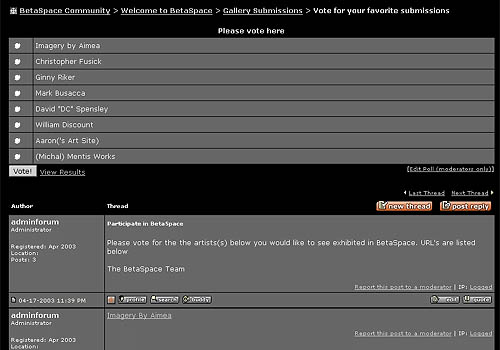
Instead, our new system would allow users to submit a
URL linking specific art work they wished to be considered
exhibited. Once their URL is up for everyone to evaluate,
the voting process can take place, and curation is then
done 'by the people, for the people'.

Marketing
and
Promotion
Although we had begun our marketing and
promotion campaign in the Winter quarter, we maximized
our efforts in several areas in the past
few months.
Through a contact at plado.org (a
popular local exhibition of multimedia and
traditional artists), we were able to distribute promo
postcards as well as get a
link on plado's Web site which gets hundreds of visiting artists
every month.
Another important campaign arose from
the organizers of the Flashforward Conference
2003, allowing
us to include our postcards in 1,500 'goodie'
bags to their attendees.
Additionally, we've been promoting BetaSpace at art schools, film schools, video
forums, Flash forums, Photoshop groups, Craigslist,
personal contacts, message boards, Usenet / Newsgroups,
and search engines, just to name a few.
Final Defense Presentation
Meeting notes and important correspondence
from Spring 2003
Return to top
|